
Running a Sex Offender Check in Queens County
The New York State Sex Offender Registry is administered by the Division of Criminal Justice Services, or DCJS. Its public web directory covers Level 2 and Level 3 registrants. Courts set those risk levels. Queens County has no separate county sheriff registry or borough database to search first. NYPD is the local law-enforcement agency for a registrant who lives in Queens, while DCJS keeps the statewide registry and publishes the authorized public data.
Start with the reason for the search. A name, Queens County, or ZIP Code search works for a known person or a broad look at listed Level 2 and 3 records. A Level 1 or undetermined-risk inquiry requires the registry hotline and a strong identifier. NY-Alert can then track later moves by people listed online. If the person may live outside New York, the national portal supplies a wider check. These sources support personal safety and neighborhood awareness. They do not establish that every person with a similar name is the same individual.
Queens Level 1 Registry Hotline
An empty online search is not a full Queens County registry check. New York does not publish Level 1 profiles in the online directory. The same limit applies when a court has not yet assigned a risk level. For those records, call the DCJS Sex Offender Registry at 800-262-3257 or 518-457-5837. Give the person's name and at least one exact identifier: a full address, complete date of birth, driver's-license number, or Social Security number.
The hotline route prevents a common mistake. A caller should not treat no web result as proof that no registration exists. Gather accurate details before calling, because a partial name alone may not distinguish people. Do not post or share the private identifier used to make the request. The identifier helps DCJS find the right record; it is not part of a public neighborhood notice. A hotline response also remains separate from a court docket or an arrest file.
Note: The Queens County online directory omits Level 1 records by design, so the hotline is an essential public-access channel.
Searching the New York State Sex Offender Registry
The official Level 2 and 3 directory lets a user search by a person's name or by place. Select Queens for a county search, or enter a five-digit ZIP Code for a more focused area. The official interface does not promise a general street-address radius tool, so do not assume that a ZIP search maps every nearby address. Review the conditions of use before opening any record.
- Open the official directory and read its public-use terms.
- Choose a name, Queens County, or ZIP Code search and enter the known details.
- Compare the result list by name, photo, age, physical traits, and listed area.
- Open the profile and read the risk level, designation, offense, address, and status together.
The captured DCJS directory search shows the official starting point without displaying any individual registrant.
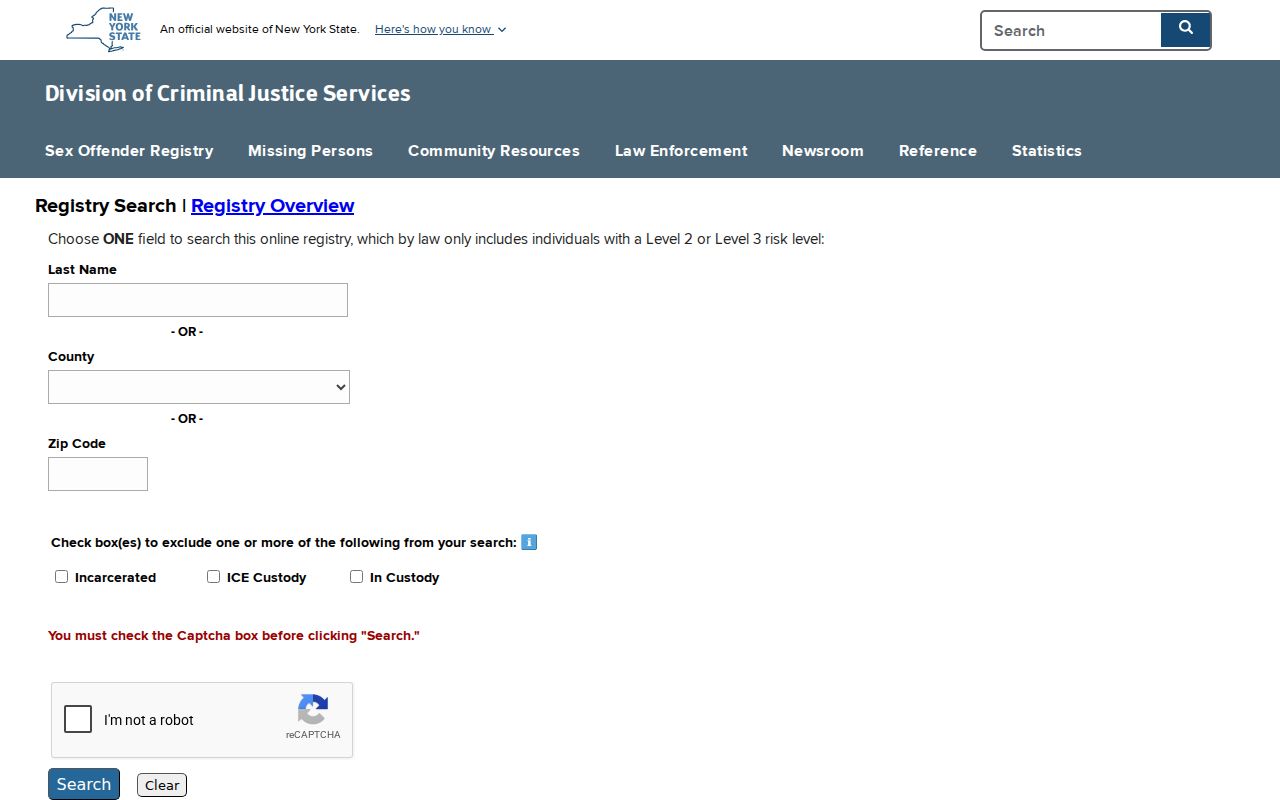
That search form is the correct web channel for public Level 2 and Level 3 registry entries tied to Queens County.
| Field Label | Type | Required | Notes |
|---|---|---|---|
| Last Name | Text | Route dependent | Starts a Level 2 or 3 name search |
| First Name | Text | Optional | Narrows a surname search |
| County | Dropdown | Alternative | Select Queens for county results |
| ZIP Code | Text | Alternative | Use a five-digit ZIP Code |
| Search | Button | Yes | Runs the chosen search route |
| New Search/Reset | Button or link | No | Clears the prior search |
Queens Registry Alerts Through NY-Alert
A one-time Queens County sex offender search can become stale when a listed person moves. NY-Alert registry notifications provide the state's relocation channel for Level 2 and Level 3 people who appear in the online directory. The service is useful for continued community awareness after the first search. It does not expand the directory to Level 1 records, and it should not replace the hotline when that lower level is relevant.
The official DCJS registry overview explains the public directory limit, the telephone search, and the relocation-alert option in one place.
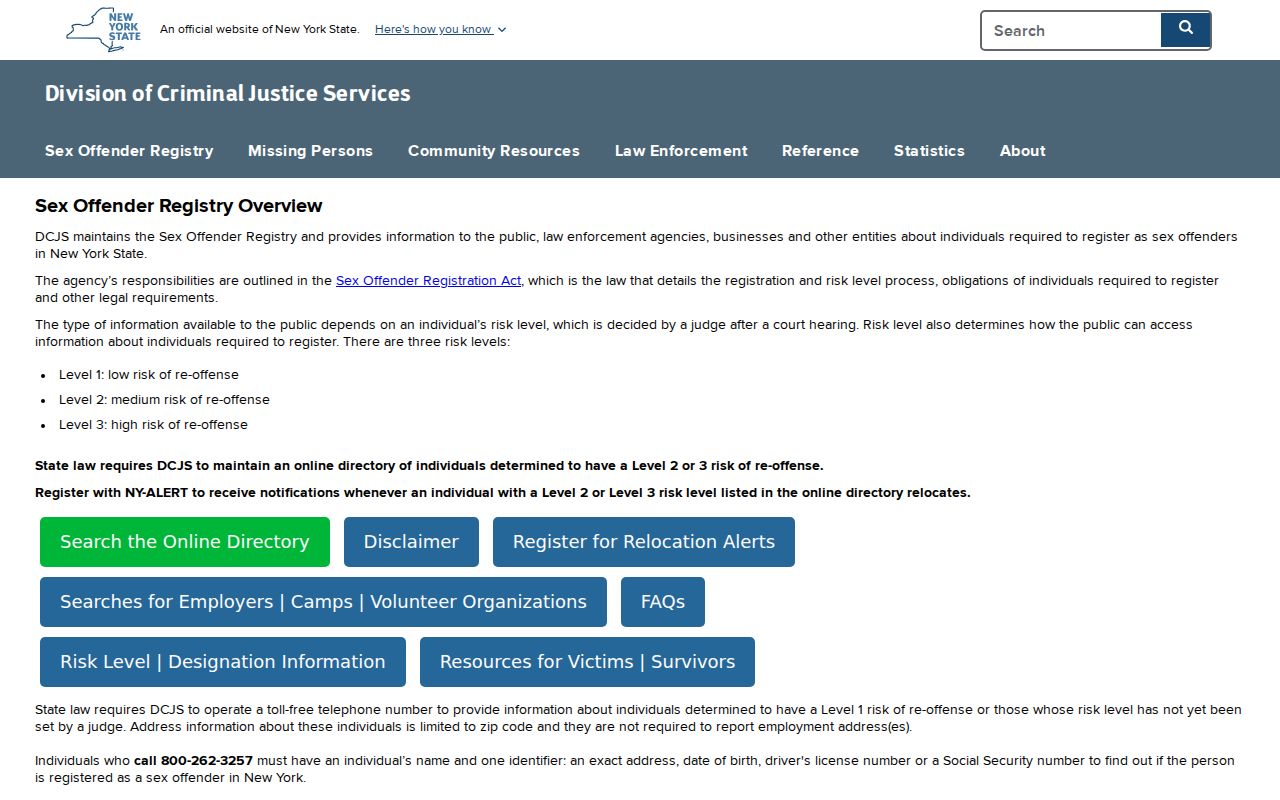
The overview makes clear why Queens County residents may need both the directory and the state notification service.
What a Registry Profile Shows
A public profile brings several kinds of information together, but the display can vary from one record to another. Match more than a name. Read the photo and physical description, then compare age, aliases, registered address, risk level, designation, and current registration status. DCJS may also publish conviction and jurisdiction details, authorized facts about the conduct or type of victim, identifying marks, vehicle information, and certain higher-education or work-location data when law permits.
| Name and Aliases | Primary name plus other names reported for the registrant |
|---|---|
| Photo and Description | Photograph, age or birth details, sex, race, height, weight, hair, eyes, and possible marks |
| Registered Address | Address information that New York law authorizes DCJS to disclose |
| Offense and Jurisdiction | Registry-qualifying conviction and the place tied to that case |
| Risk and Designation | Court-assigned level plus any predator, sexually violent, or predicate designation |
| Registration Status | Current status and other publicly releasable registry details |
A registry profile is not a full criminal history. For the charge history, filings, disposition, and sentence, the Queens County criminal court case record is the more direct source.
Queens Registry Roles: NYPD and DCJS
Queens County does not follow the county-sheriff model used in many parts of the country. NYPD serves as the local law-enforcement agency for Queens registrants, and DCJS administers the registry statewide. Courts assign the risk level after a hearing, often at sentencing in a probation case or before release from incarceration. A person who moves into New York must register within ten days when the law applies.
Address checks and changes are governed by Correction Law Article 6-C. Local law enforcement may give notice to entities that serve vulnerable groups when the statute authorizes it. For a Queens address, use the official Queens precinct directory to identify the proper NYPD command. The New York City Sheriff's Office is not the borough's criminal registry or jail agency.
Note: Risk level measures the court's assessment, while a statutory designation can independently change how long registration lasts.
Registration Requirements and Levels in New York
New York courts use three risk levels, but duration cannot be read from level alone. A Level 1 person without a lifetime designation generally registers for twenty years under current post-2006 rules. Level 2 without a lifetime designation generally lasts thirty years. Level 3 lasts for life, as do the sexual predator, sexually violent offender, and predicate sex offender designations. Older dates, amendments, and a federal injunction involving certain older cases can change what the public sees. Check the DCJS risk and registration guidance for the individual facts.
| Classification | Public Channel | Duration |
|---|---|---|
| Level 1, no designation | Hotline with name and identifier; not online | Generally 20 years under current post-2006 rules |
| Level 2, no lifetime designation | Online directory and hotline | Generally 30 years |
| Level 3 | Online directory and hotline | Life |
| Predator, sexually violent, or predicate designation | Access depends on level; designation may be shown | Life |
The distinction between level and designation matters in Queens County. A low risk label does not cancel a lifetime designation, while a Level 2 record without such a designation may have a finite term. The conviction date and classification date also matter. DCJS notes that a federal injunction limits online publication for some people whose offenses predate 1996 and whose risk classifications occurred before 2000. That gap is another reason to use the hotline when a careful Queens registry search does not yield an online profile.
Queens Registry Searches Beyond New York
The National Sex Offender Public Website, or NSOPW, adds a federal search across participating state, territorial, and tribal registries. It is useful when a person recently arrived in Queens County, has moved away, or may have records in more than one state. NSOPW does not replace New York's rules about which levels appear online. It sends the search through the public information supplied by each participating jurisdiction.
Use both layers when geography is unclear. Start with the New York directory for a Queens County address and the state's own profile details. Then check NSOPW for public records elsewhere. If New York's web search is empty but Level 1 registration is still possible, call DCJS. Differences between systems can reflect disclosure rules, a move, a classification date, or update timing. They do not support a snap claim that one system is wrong.
Lawful Use and Community Notification
Registry information serves public protection, family safety, and sound community awareness. It should be read with care and used without direct contact or retaliation. New York permits public notice within the boundaries set by law. It does not authorize a reader to threaten, follow, shame, or expose more private data about a registrant or household. A profile also should not be used to infer a new offense that has not been reported or proved.
Misuse is unlawful: Correction Law Article 6-C, including §168-q, forbids misuse of registry information. Harassment, threats, vigilantism, or unlawful discrimination may lead to criminal or civil consequences.
Community notice does not turn a Queens County registry record into permission for private enforcement. Let NYPD and DCJS handle compliance, updates, and any safety inquiry that needs nonpublic facts.
Report Queens Registry Noncompliance
Suspected noncompliance should go to the agencies charged with enforcement. Preserve the public profile URL, note the date and time, and write down the specific fact that appears inconsistent. For a nonemergency tied to a Queens location, contact the appropriate NYPD command from the borough precinct directory. DCJS can address questions about the state registry record and its public status.
Do not visit the listed address, confront the person, track family members, or publish added private information. Call 911 only when there is an immediate emergency. A stale address or a profile that looks incomplete is a reason to report a concern, not a license to investigate someone in person. This route keeps the focus on public safety and lets NYPD or DCJS compare the report with information that is not lawfully available to the public.