
Criminal Cases in the Queens County Courts
Queens County has no separate municipal court system. The New York City Criminal Court at 125-01 Queens Boulevard handles misdemeanors, violations, arraignments, and the first stages of felony complaints. A felony matter does not begin in Supreme Court merely because the arrest charge is serious. It reaches Queens Supreme Court, Criminal Term after a grand jury indictment or an authorized waiver that leads to a superior court information, often shortened to SCI.
The Queens Supreme Court Criminal Term then holds the indicted felony case file. Both courts operate at the Kew Gardens complex, yet their dockets and clerk units remain distinct. That split explains why a single name search may show a Criminal Court docket first and a Supreme Court indictment later. Queens court case records follow the filed accusation, not the first police label.
Which Queens Court Holds the File
Start with the court shown on the latest docket entry. A misdemeanor information usually stays with Queens Criminal Court. A felony complaint begins there, but the file path changes if the grand jury returns an indictment. At that point, the indicted case belongs to Queens Supreme Court Criminal Term. An SCI also places the felony in Supreme Court when indictment is lawfully waived.
This court split matters when requesting papers. Criminal Court can address its arraignment and lower-court docket. Supreme Court holds the post-indictment felony record, including its motions, plea or trial events, sentence, and certified disposition. Queens specialty parts, including Treatment Court/Mental Health Court, Integrated Domestic Violence, and Queens Youth Part, may change the part or program route. They do not make protected treatment details public.
For an indicted felony, use the Supreme Main Record Room at 718-298-1400 or the Annex Record Room at 718-298-1455. For a misdemeanor or preliminary felony docket, contact Queens Criminal Court through its general directory at 718-298-0888. Give the docket, indictment, or SCI number whenever possible.
How to Search Case Records
The free eCourts WebCriminal search is the first public route for a pending or recent Queens criminal case. It can identify the court, case number, status, charge, and next appearance. It is an index and docket view, not a promise that every filed paper can be downloaded. Use this five-step path:
- Choose the defendant-name route or the case-number route in WebCriminal.
- Enter the legal name, or preserve the punctuation and year format in the docket or indictment number.
- Apply the Queens County and court filters to reduce common-name matches.
- Open the result and record its court, number, status, part, next date, charge, and disposition.
- Call the correct Queens record room for papers, inspection, or a certified disposition that is not available online.
These are the documented fields on the public defendant-search interface:
| Field label | Type | Required | Search note |
|---|---|---|---|
| Search by Defendant / Case Number | Tab or radio | One route | Switches the form between name and identifier searches |
| Last Name | Text | Name route | Use the legal spelling; partial behavior may vary |
| First Name | Text | Expected | Helps separate common Queens names |
| County | Dropdown | No | Select Queens for county scope |
| Court | Dropdown | No | Choose Criminal Court or Supreme Criminal Term when listed |
| Case, Docket, or Indictment Number | Text | Identifier route | Keep the court format, year, and punctuation |
Read Queens WebCriminal Results Carefully
WebCriminal answers a public court question. It does not produce a fingerprint-matched New York rap sheet. The New York State Office of Court Administration also offers Criminal History Record Search, or CHRS, as a paid statewide exact-name and date-of-birth search of public court records. CHRS may return more than one possible match. It does not establish that every match belongs to the same person.
By contrast, the New York State Division of Criminal Justice Services gives a Personal Record Review only to the subject or the subject's attorney after fingerprints. DCJS criminal-history records are not public through the New York Freedom of Information Law. Someone reviewing their own full fingerprint-linked history should use DCJS Personal Record Review, then compare any questionable cycle with a Queens certificate of disposition.
If WebCriminal shows no hit, retry spelling variants and the case identifier. Then ask the clerk. A sealed matter, youthful-offender adjudication, older file, some summons matters, or a data-entry delay can explain the absence. No online result is proof that no Queens case exists.
What the Case File Shows
A Queens criminal case file records what prosecutors filed and what the court did. It may show a felony complaint, information, indictment, or SCI, followed by appearances, motions, a plea or trial, the disposition, and sentence. That sequence can differ from the original arrest report because charges may be reduced, replaced, dismissed, or resolved under another offense.
| Case Number and Court | The docket, indictment, or SCI number and the Queens court that holds the case |
|---|---|
| Charging Document | The complaint, information, indictment, or SCI that states the filed accusation |
| Docket Entries | Arraignments, adjournments, motions, hearings, pleas, trials, warrants, and other recorded events |
| Hearing Dates | Past and next appearances, court part, time, judge, and stated purpose when public |
| Disposition and Judgment | Dismissal, plea, verdict, or other formal outcome for the case or charge |
| Sentence and Conditions | The penalty imposed after a conviction, including public custody or supervision terms |
Public views exclude Social Security numbers, full financial identifiers, protected victim or minor details, and sealed or youthful-offender material. Some public papers are inspectable through the clerk even when no download appears online.
Order Queens Case Dispositions by Mail
A certificate of disposition is a clerk-certified statement of a case outcome. It is often the most useful Queens record for correcting an outcome, proving that a charge was dismissed, or matching a court result to a person's own DCJS record. It is not a full criminal-history search and does not replace the full docket.
For Queens Supreme Court, request the certificate at Room E121 or mail the defendant name, indictment number, and return address to Queens Supreme Court, 125-01 Queens Blvd., Kew Gardens, NY 11415, Attn: Correspondence Unit, Room E121. Include a $10 U.S. postal money order or bank check payable to SNY Supreme Court Queens County. The court estimates 7 to 10 business days for the mail route.
The official Queens record-room directory shows which unit to call before sending a request.
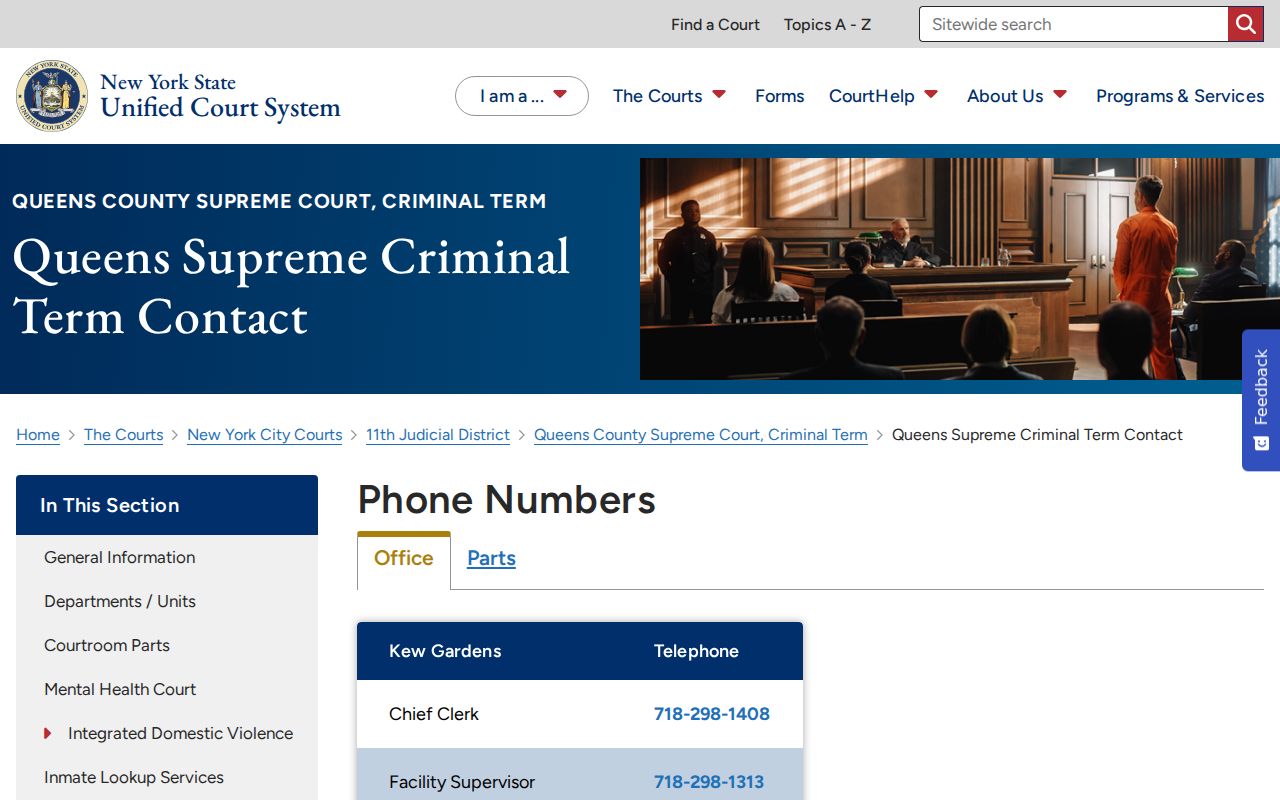
The directory helps route a request to the Main Record Room, Annex Record Room, Correspondence Unit, or Motion Clerk instead of treating the courthouse as one file counter.
Stages of a Criminal Case
A Queens prosecution may start with a custodial arrest or a desk appearance ticket. Criminal Court conducts arraignment and addresses release, bail where permitted, or remand. A misdemeanor proceeds on an information. A felony complaint can move to a grand jury, followed by indictment or an authorized SCI and a new arraignment in Supreme Court.
Case flow: Charges Filed → Arraignment → Pretrial → Plea or Trial → Disposition → Sentencing
Pretrial work can include discovery, motion practice, hearings, and adjournments. A plea may resolve the Queens case without trial. If a trial occurs, the verdict comes before sentencing on any conviction. An appeal creates a later record track, but the trial clerk remains the place to confirm the original disposition and sentence.
For the broader flow from police custody into the court file, the county's Queens County arrest history resource distinguishes the arrest charge from the accusation that prosecutors later file.
Read Queens Criminal Case Terms
A few local docket terms reveal where a Queens case sits. Read each in the context of the court, case number, and date. The same person may have a Criminal Court docket and a later Supreme Court indictment for one prosecution.
- Felony complaint
- A lower-court pleading that alleges a felony before an indictment or SCI.
- Indictment
- A grand-jury accusation filed in Queens Supreme Court.
- SCI
- A superior court information used when indictment is waived as state law permits.
- Disposition
- The formal outcome of a charge or the case, such as dismissal, plea, or verdict.
- Bench warrant
- A judge's order commonly issued after a missed appearance or failure to comply.
An arrest charge is not a disposition. Nor does an indictment prove guilt. The final Queens court record may show a plea to a different offense, a dismissal, an acquittal, or a sentence that the first police record could not predict.
Access & Restrictions
New York court files are generally open unless a law or court order restricts them. Judiciary Law section 255 directs clerks to search court files and certify records upon a lawful request and payment of the required fee. Executive-agency records follow FOIL, but that is not the route for obtaining a court case file from the clerk.
Sealed cases, youthful-offender records, grand-jury material, and protected victim information are withheld. CPL 160.50 generally seals records when a criminal action ends in the accused's favor, subject to statutory exceptions. New York's other sealing rules can also narrow public access. A clerk may release a redacted public portion while keeping protected material out of view.
If a public case vanishes after a sealing event, do not infer that the record was deleted or that an old copy remains current. Verify the present status with the originating Queens court.
Resolve a Queens Bench Warrant
No complete public Queens warrant list was verified. WebCriminal may display a bench-warrant status after a missed date, but search warrants and sealed arrest warrants are not public before execution. A blank search cannot safely clear a warrant concern, and an NYPD FOIL request is not a real-time warrant check.
The Queens court guidance directs a person who missed court to contact counsel and report as directed, including the next business day when applicable. First identify the case number and issuing court. Then call the proper clerk or record room, speak with counsel, and follow the court's instructions. Only the issuing court can address the warrant and enter the later order that vacates it.
Do not go to an unrelated precinct expecting staff to cancel a court order. Federal, out-of-state, parole, and other warrant types follow different authorities. For a Queens bench warrant tied to a pending case, use the docket to locate the court and confirm the next lawful step.